My life has been a love affair with oblivion.
Dictionary.com defines oblivion in the following ways:
- the state of being completely forgotten or unknown.
- the state of forgetting or of being oblivious.
- the act or process of dying out; complete annihilation or extinction.
At least from my early teenage years, I had the desire to somehow fade out, disappear, forget myself completely, or be absolutely annihilated with no trace remaining. Don’t get me wrong—this wasn’t a desire to physically die. Theories about reincarnation notwithstanding, physical death never felt final enough for me. And also, somehow, I wanted to be present in this experience of oblivion—I wanted to be swimming in it, bathing in it, evaporating and dissolving within an endless and unfathomable space of nothingness.
Recently, as I had some time off from my day-job, I have been enjoying composing music on my laptop with the help of a DAW and my MIDI keyboard. Though obsessed with playing and writing music from the age of fourteen, I haven’t written any music like this in a few years. My last artistic foray was when I completed my first collection of poetry, For Things That Pass, last year. I don’t relate these projects, of poetry and music, to my continuous writings on spirituality that form the ongoing Avadhutam collection of books. Somehow, I see those writings as having absolutely nothing to do with me as a personality or as an individual at all. With those writings, I try to remain as a pure conduit for the messages of guru mandala to flow forth and reach people. This differs from my music, poetry, and maybe upcoming blog posts on here, which are directly related to me as a person, my personal history, my opinions, and my tastes in music, film, and literature. So, really I have created this blog as an outlet for that side of myself to be expressed.
People may have a distorted notion that when self-realisation occurs, the personality, the individuality just disappears. My experience of this—even though I don’t know whether I am self-realised or not—is that the areas of the personality that are related to suffering and misery are dissolved. The personality still remains as vehicle for expression. And what is interesting is that without the hang-ups, insecurities and complexities that usually haunt a personality, the potential for creative expression becomes supercharged and absolutely freed. The freedom comes from the fact that such creativity has no ambition behind it. When I was younger, I had ideas about becoming a musician, poet, philosopher, or writer. I now have no such ideas. I am now just a simple person who does these things exactly when he feels like doing them. If I never write another piece of music again, I don’t care—I have nothing to lose and I don’t identify myself as a musician. I don’t identify myself as a writer, philosopher, poet, yogi, or any of these things either. For me, all identifications are illusions and total wastes of time. Better to exist as a simple piece of life—a simple throb of existence.
So anyway, despite me saying that my art is distinct and separate from my spiritual writings, all of my art-creations are about the same thing—life as it is experienced through silence, through pure energy and unconfined awareness. And this style is deeply rooted in my tastes as an enjoyer of music, film, and literature.
I was recently talking to my friend about a couple of classic films—There Will Be Blood & No Country For Old Men. After both gushing about Daniel Day-Lewis’ intense and unintentionally amusing tour de force performance in There Will Be Blood, he said that he preferred that movie over No Country For Old Men. I countered by saying that my love for Coen Brothers’ movie is deeply personal:
‘And yes both films are masterpieces. You know, my love for NCFOM is personal. It’s the sparseness—of the landscape, and all also of the dialogue. Each character is like a man of few words.
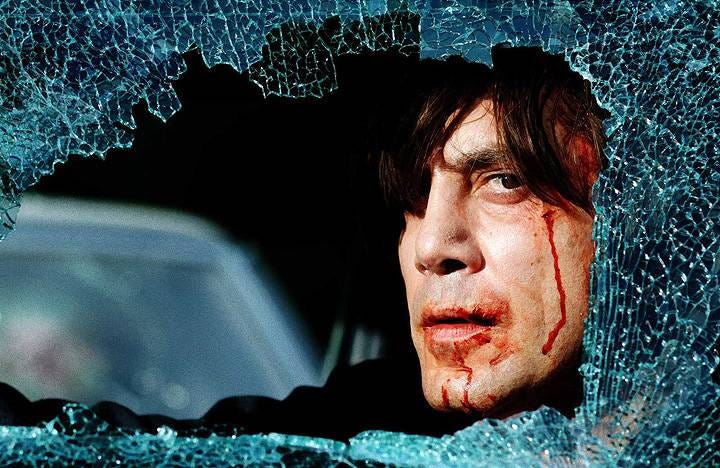
I was always obsessed with this kind of sparseness as a kind of simulacra of silence. I was always longing to be annihilated in some oblivion. I sometimes used to fantasise about living a kind of simple rural existence in those kind of places—rural Texas. I was also obsessed with the original Texas Chain Saw Massacre, 1974.
I lost those obsessions somewhere along the way. So maybe I reached that oblivion by accident. Who knows.’
I tangibly remember, before I was anywhere even close to spiritual awakening, that I would enjoy procuring numerous cans of strong continental lager after work on a Friday and re-watching the same films, and listening to the same music, which communicated that overwhelming sense of oblivion to me.
Apocalypse Now, Deer Hunter, No Country For Old Men, True Detective Season 1, the song Nothin’ by Townes Van Zandt, the original Texas Chain Saw Massacre Movie, and the list goes on…
It wasn’t the art itself that I was interested in. I was interested in accessing something through the art. That thing was a massive sense of emptiness, desolation, sparseness, silence, and total dissolution of all personal identity. Even before I knew anything about spirituality, I had the same longing for this unknown all-vanquishing space of stillness and identitylessness.
In my early teenage years, I was also fascinated with the literary works of Samuel Beckett. I even remember when I moved into my own place for the first time, I had a framed picture of both Samuel Beckett and the Hungarian composer Bela Bartok near my piano and messy desk. I suppose that this was a kind of prelude to later having pictures of great avadhutas like Shirdi Sai Baba, Bhagavan Nityananda, Shiva Prabhakara Siddha Yogi, and Mohanji in my house.
In short, I was always searching for emptiness, and in my formative years, I was searching for, and to some degree, finding that emptiness in powerful works of music and literature.
When I read Samuel Beckett’s books for the first time, I felt such a degree of resonance that I believed I must have been him in my past life. Here is a beautiful passage from one of his novels, The Unnamable:
‘I have no explanations to offer, none to demand, the comma will come where I’ll drown for good, then the silence, I believe it this evening, still this evening, how it drags on, I’ve no objection, perhaps it’s springtime, violets, no, that’s autumn, there’s a time for everything, for the things that pass, the things that end, they could never get me to understand that, the things that stir, depart, return, a light changing, they could never get me to see that, and death into the bargain, a voice dying, that’s a good one, silence at last, not a murmur, no air, no one listening, not for the likes of me, amen, on we go. Enormous prison, like a hundred thousand cathedrals…’
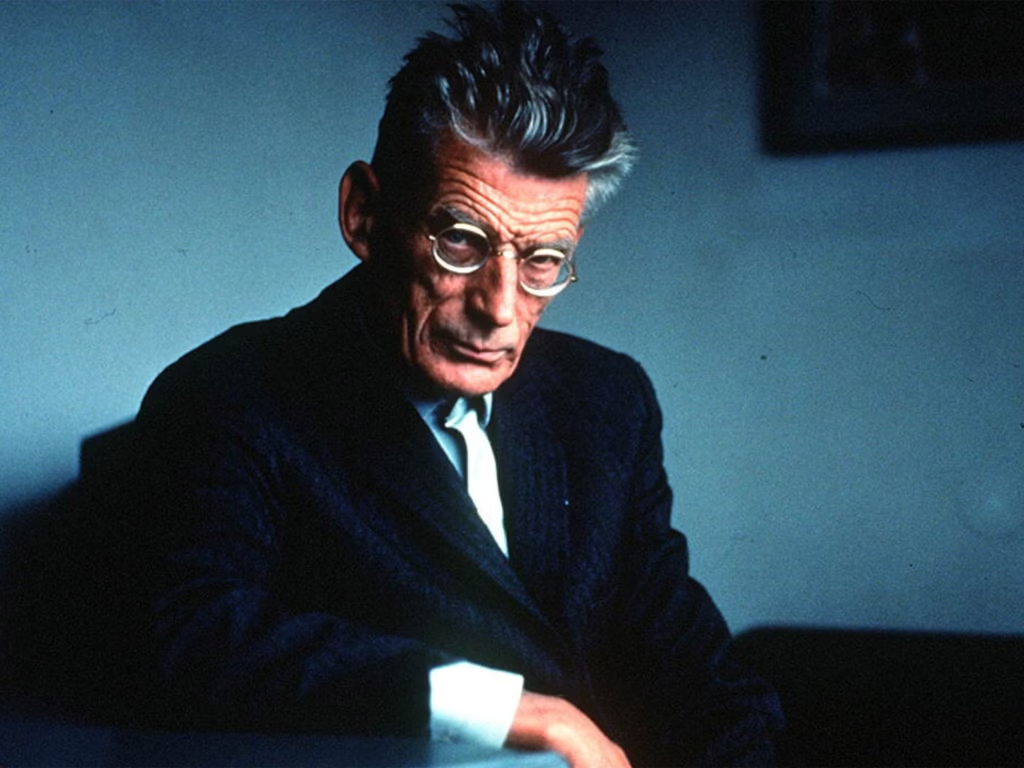
Interestingly, these three books, his trilogy, Molloy, Malone Dies, and The Unnamable unfold from the perspective of a kind of formless narrator, who, starts to sound a lot like God himself, or the very formless, empty essence of existence that puts on all the masks involved in the dance of created existence.
As you can also see, I stole the title for my poetry book, For Things That Pass, directly from this passage of Beckett. However, it was terms like ‘a hundred thousand cathedrals’ that really got me going—that really got me very excited and inspired. Really, anything that suggested great vastness, silence, and a negation of personal self-identity, seemed to act like trigger that would, to some degree, transport me back to that experience as if it were an old friend that I had known long ago.
Well, now, like I said in the message to my friend, I no longer feeling like I’m searching for oblivion or silence. But it still seems like the impression of this love affair lingers within me. So, I will let this impression express itself freely. I will let it enjoy itself. Why not?
A man, a tree, a god, an impression, a love, a hate—are all of these things not expressions of the supreme consciousness? All of these things are dancing, are enjoying, whether we like it or not. Life is going. Life is moving. We cannot stop it. Better to merge with it. Better to merge into that supreme dancer and totally lose ourselves in the wildness of that mad dance.
This merging can only happen when we are totally loose and totally carefree. The words of sages are nice, but the way that they live is even better. The words of a sage are their beginner teachings; their life is their advanced teaching. Overall, we must let life breathe.
Anyway, here are few of my own recent artistic offerings from the past couple of years that, to some degree, emanate that oblivion, that beautiful oblivion…
Poetry
THE BULRUSHES
In the bulrushes is where I’m at my best
Yes, there I am not seen
And there I do not know what I am
I could be anything of water, land or air
Pre-formed, pre-existent
Only when I emerge, do I assume my shape
In the eyes of others
Let them have their shapes and names
I’m happy in my bulrushes
Undiscovered, primordial
Incomprehensibly beautiful
THE MEETING
The first time we met
In a crowded elevator
I was in a state of panic
And you were completely indifferent
The second time we met
In an empty park
I was lost
And you were found
The third time we met
I didn’t know where I was
I didn’t know who I was
And I didn’t know who you were
We didn’t meet again
All meetings were finished
In that perfect moment
Of emptiness
Music
REFERENCES
Samuel Beckett, The Unnamable (Faber and Faber, 2010), 163.
Jack H. Barratt, For Things That Pass, 7, 16.