Last night, I watched the film Magnolia by Paul Thomas Anderson for the first time in about ten years. I felt that the movie addressed some very deep themes about human life. Here are some disorganised thoughts on the topic of masks in relation to the film:
(Spoilers ahead!!!)
Most of us wear masks. Each of us have a face that we display to different people in different situations. Many of us also have a face that we keep entirely to ourselves. Magnolia talks about masks in a number of ways.
FRANK
The most obvious scene that addresses the theme of masks is the TV interview with Tom Cruise’s cocky pick-up artist character, Frank T. J. Mackey. What we witness during the course of the interview, as the journalist probes deeper and deeper into Frank’s concealed, obfuscated past, is a gradual removal of his mask.
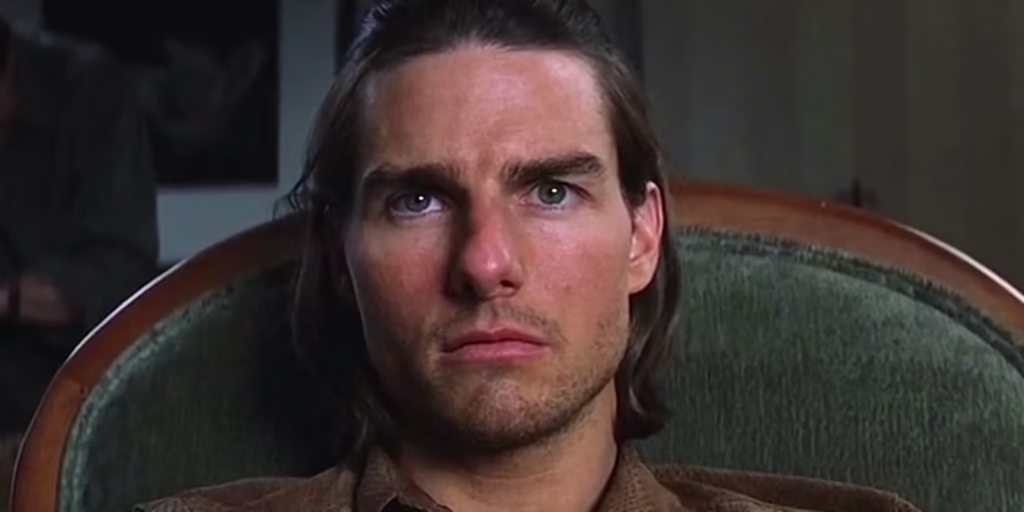
As the journalist tactfully brings up things like the fact that Frank’s TV producer father, Earl Partridge, walked out on him and his mother, and left him to care for her alone as she died, we watch as Frank falls into an almost dissociative state. As the mask of carefree confidence is removed, we are shown the core of absolute devastation that he really inhabits. From this point on, he doesn’t answer any more of her questions, remaining silent until the scheduled interview time runs out. Why? Frank has never really learnt to function without his mask. Without his comfortable mask of being a successful pick-up artist and leader of his sex-starved, sycophantic followers, he literally is unable to speak or communicate.
This is the danger of masks. With time, they become our face. The more we get used to wearing a mask, the more our real face becomes deeply buried within. The process of recovering our real face is not easy. For this to happen, we first must be shocked out of our mask-wearing habits. In the movie, this shock happens in what seems to be the space of an hour or two for Cruise’s character. First, he is confronted by the journalist who tries to forcibly remove his mask from him. After he has aggressively cursed at the journalist, stormed out and returned to preach to his followers, he is given the news that his estranged father is on his deathbed.
It is only when Cruise sits in front of his dying father that the character of Frank T. J. Mackey evaporates and we get to see the devastated, resentful, deeply hurt child who, behind his well-rehearsed, fake personality, has been living in a state of emotionally suspended animation since his childhood. This scene flowed like a surge of water exploding from a collapsed dam. Cruise’s characters explodes with all of his anger, rage, resentment, bitterness, and pain.
Cruise’s tearful one-sided colloquy with his silently departing father ends with the words: ‘You fucking asshole. Don’t go away you fucking asshole. Don’t go away…’ This was an expression of the fact that, even though he hated his father, he still loved him deep down. It was an exact replay of his childhood dynamic: The father that he loved was going away. He didn’t want him to go away. He resented him going away, but he loved him anyway.
A sad aspect of life is that it often takes events like this to trigger people into taking their masks off. Well, they don’t really take them off—the situations themselves tear the masks from them unceremoniously. This is all a part of the learning in life. The more disintegrated we are within ourselves, the more fragile we are, and the more susceptible we are to being hurt by others, by ourselves, and by situations.
Usually, those who are most fragile are the ones who have created the hardest, sharpest exteriors. This is evident in Magnolia with the character of Frank T. J. Mackey, who seems utterly invulnerable, like a god amongst men at the beginning of the film. His slogan and directive to women to ‘worship the cock’, is a projection of the false god, the false personality, that he worships in order to remain safely insulated from his own well-concealed pain and resentment. But such disguises are never complete anyway. When traumas are concealed, they usually bleed through to the surface somehow in ways that are quite unpleasant. In Frank, the unpleasantness is manifested in the form of the absolute prick of a character that he has created for himself as a disguise. The unpleasantness of his memories, left to fester within, bled through the surface in the form of a misogynistic, insensitive character who, not coincidentally, was quite similar in form and function to the womanising, physically and emotionally absent, father of his childhood.
When his father passes away, we see Cruise’s character in emotional ruins. He is in a state of extreme vulnerability. His mask has been torn from him, and he now he has a choice whether to step on the path to living without a mask.
CLAUDIA
Another pair of characters in Magnolia who come face to face with the issue of masks is Jim, a love-seeking, pious police officer, and Claudia, a traumatised cocaine addict. The issue of masks come to the fore when these two characters go on a date. What brings them together is their deep loneliness and genuine longing for human connection. Claudia, who was molested by her TV-host father as a child, seems to possess a genuine will to heal and become more whole. Even though she masks this tendency through her avid cocaine use and indulgence in casual sex, she displays her will to heal through her challenging Jim to begin their fledgling connection in an unmasked state:
‘Ok, I’ll tell you everything, and you tell me everything, and maybe we can get through all the piss and shit and lies that kill other people.’
This is not the cry of somebody who is looking for a casual connection. It is the call of somebody who is looking for a genuine relationship that can also be used as a means to heal herself. This is actually one of the amazing functions of relationships. If we want to go deeper into a connection with somebody, we must gradually remove our masks. Physical intimacy can be used as an analogy for this: if we wish to have sex with someone, we must take our clothes off. Likewise, if we want to enter into some kind of emotional union with someone, we must also disrobe ourselves of the layers of bullshit that we use to protect ourselves from being hurt.
Later in their interaction, Jim confesses that earlier in the day he lost his service gun at work, making him the laughing stock of the entire police station. He admits that he was scared to tell her this because he was afraid that she would judge him and think that he was a fool. Strangely, his admittance has the opposite effect. You can feel the two characters become closer after this confession. Claudia tells him that she thinks that it is amazing what he just did.
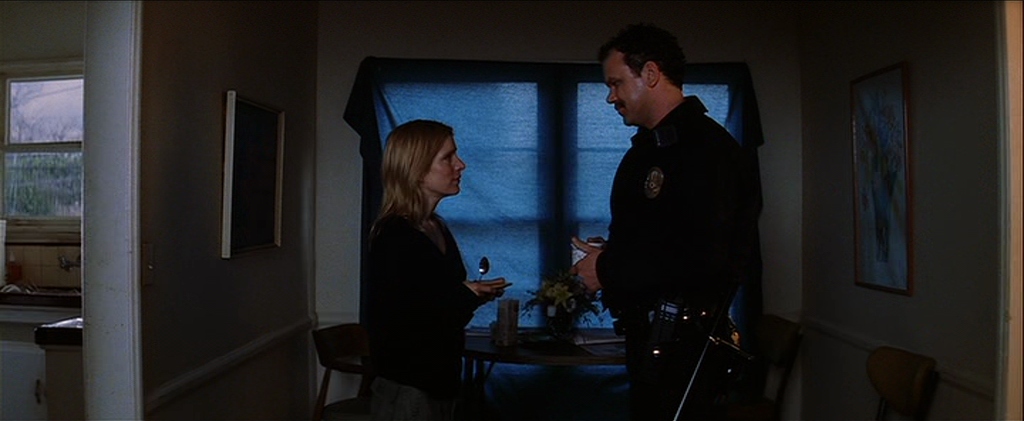
After this, the interaction proceeds in the direction of Claudia feeling Jim out, feeling how much of herself she can safely disclose to him without him running away. He tries to reassure her that he will be a good listener and he won’t judge her. What we witness here is the start of what, even in an ideal world, would be a long journey of healing, where Claudia would gradually learn to trust Jim, and vice-versa. By admitting what had happened to her to another person, to a non-judgemental presence, she would slowly begin the process of healing and coming to terms with her own buried traumas, which, in a similar way to Frank’s character, have been finding their expression in other self-destructive behaviours.
Later on in the date, Jim and Claudia kiss, and then, perhaps overwhelmed with her newfound intimacy, she runs out on him. The final time we see them in the film involves Claudia sitting up in bed crying while Jim reassures her that she is a ‘good, beautiful person’. Like Tom Cruise’s character, a door has been opened for Claudia to gradually work her way out of a compressed, masked existence, and finally begin the healing journey. It is left to us to imagine the later trajectories of these characters’ lives.
US
Masks are not removed in a vacuum. They are removed by life, the greatest teacher. Through situations, through loss, through relationships—through all of these things life always invites us to be a more genuine, authentic person, who therefore has more fulfilling and enriching experiences.
The removal of masks is a messy job. It involves tears. It involves facing things that we do not want to face. It involves really learning to feel ourselves deeply. It involves giving ourselves permission to feel things that we have blocked ourselves from feeling. It involves gradually learning to trust others and ourselves.
In Magnolia, through the characters of Frank and Claudia, we see that a masked existence can express itself in a variety of ways. Frank’s characters looks super well put together and successful. At the start of the film, he is shown actually preaching to a roomful of men about life. Claudia, on the other hand, seems to be devastated from the get-go. Though their presentations are quite different, both of these characters are living lives that are active responses to their childhood traumas.
A mask is simply something that covers what is really there. A masked existence is a suffocating existence. In such a mode of living, it is impossible to live with any sense of spontaneity and freedom. The masks creates a filter, a barrier, between us and life, between us and others. Masks make us stiff and afraid, just like Frank when the journalist begins to prod into his past.
The first step to removing our masks is knowing that they are there. We begin to sense their presence when we actually feel the suffocation that they cause.
For me, one phrase that may be used to describe this film, Magnolia, is ‘emotional suffocation’.
Oh, but why would anyone want to watch a movie that feels like emotional suffocation? Because such films can teach us something about ourselves. Art is not just for entertainment. Art should be an integrative part of an actual evolutionary journey through life. Films and music should assist us on that journey. An apparent piece of art that simply numbs us and puts us to sleep is useless. And sometimes the problem is not the art but the attitude with which we are engaging with it.
A person who is oriented towards growth, towards expansion, towards healing, will learn from anything and everything in life. This is something I hope to dive in to through the wide variety of topics and source material on this new blog.
With love,
Jack